The Palaestra of the Petronii
The palaestra was not only a Greek idea. In the Roman city of Thuburbo Majus, in what is now northern Tunisia, a local family paid for their own training ground. Its columns still stand on African soil today.
Thuburbo Majus began as a Punic town on the road linking Carthage to the interior. In 27 BC the emperor Augustus settled army veterans there, and over the next two centuries it grew into a prosperous farming city trading in grain, olives and fruit. Hadrian made it a municipium and Commodus a full Roman colony; most of what survives today dates from about AD 150 to 200.
In AD 225, Publius Petronius Felix and his sons paid for the palaestra themselves. A dedication on the portico records the gift and the town council's approval, and at the opening each councillor received a coin and each civic association a larger sum. Funding public buildings like this was how wealthy families earned standing in a Roman town.
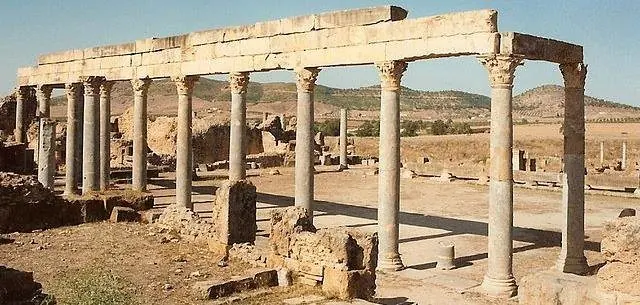
The palaestra is a large open court ringed by Corinthian columns, where people exercised or strolled in the shade. Archaeologists rebuilt the southern colonnade, the row in the photograph, from stones found on the site, and its yellow-veined marble gives the portico a striking contrast. It sits between the Summer and Winter Baths, so visitors could train and then wash next door, the Roman pairing described on our history of the palaestra page. In one corner, a stone slab is even cut as a board for duodecim scripta, a dice game a little like backgammon, a sign that people lingered here between bouts.
Why it matters to Palistra
Thuburbo Majus is a reminder that the training ground has an African chapter of its own. A city here invested in a place where people could gather, practise and improve. Palistra Academy is building the same kind of space for African professionals today, focused on a new skill.
Sources: Wikipedia, "Thuburbo Majus" · Rome Art Lover, "Thuburbo Majus" · Following Hadrian, "Thuburbo Majus" · Image: ResearchGate